
Why Some Couples Grow Closer During Renovations (And Others Fall Apart)
RenoPLNR founder Teri Allen reveals the two partnership patterns that determine whether your renovation strengthens your marriage — or strains it. This article reframes remodeling as more than a construction project — it’s a partnership test.
HOME REMODEL PLANNINGRENOVATION PLANNING
Why Some Couples Grow Closer During Renovations (And Others Fall Apart)
The two partnership patterns that determine whether your remodel strengthens or strains your relationship
Everyone warns you about it.
"Remodeling will test your marriage."
"You'll fight about everything from tile grout to cabinet hardware."
"If you survive the renovation, you can survive anything."
I've heard these warnings repeated so many times over my 12 years managing remodels that they've become accepted wisdom. The stereotype is that couples turn into adversaries during renovations—arguing over budgets, battling over design choices, disagreeing about contractor selection.
And sure, I've seen moments of tension. Decisions made when you're tired, stressed, and overwhelmed rarely bring out anyone's best self. But here's what surprised me after working with 30+ couples through major renovations:
The stereotype is wrong.
Over my years managing high-end residential remodels—overseeing more than $10 million in projects—I witnessed far more partnership, respect, compromise, and genuine support than the conflict everyone expects. It wasn't the exception. It was the norm.
The couples who successfully navigated their remodels weren't just lucky. They weren't avoiding stress by having unlimited budgets or hiring me to handle everything (though that helped). They were doing something specific. They had patterns—ways of working together that made the chaos manageable and kept their relationship intact.
I started noticing these patterns early in my career, but it took years of watching couples work through the process to understand what actually made the difference. Some couples seemed to glide through decisions that paralyzed others. Some maintained their sense of humor even when contractors missed deadlines or unexpected costs popped up. Some actually seemed closer at the end than when they started.
What were they doing differently?
After managing dozens of couples through everything from minor kitchen updates to complete home transformations, I can tell you: successful remodel partnerships aren't about avoiding disagreement. They're about how you handle the inevitable pressure points.
The couples I'm about to tell you about taught me more about partnership than any relationship book ever could. Their stories show what's possible when two people bring respect, clear communication, and genuine teamwork to one of the most stressful experiences most homeowners will ever face.
And maybe—just maybe—these stories will change how you think about tackling a remodel with your partner.
PATTERN ONE: THEY PLAYED TO EACH OTHER'S STRENGTHS
I loved working with Derrick and Lisa. They'd spent years in New York working high-level careers and raising their family. When they moved to the country, they were ecstatic that they could finally buy a good-size house with plenty of space—inside and out—for when their boys started having kids. Both sons were married and grandchildren were definitely in the plans. The property had a beautiful pool, and Derrick made me laugh when he referred to it as "kid bait."
They were taking on a full gut remodel—moving and adding walls and rooms to accommodate the growing families. We were touching everything inside and mostly everything outside too.
Right off the bat, I could see they'd staked out their territories. Mostly as you'd expect: Lisa was definitely in charge of the laundry room and would make every decision there. TVs and smart home systems were Derrick's thing, and Lisa wanted nothing to do with it. Even in the primary bath and closets, they each knew what they wanted in their own spaces.
They both had strong opinions, no doubt. But they seemed to have a mutual agreement about who took charge and made final decisions on most projects.
But the kitchen? That was mutual domain. And it was complicated. Lots of angles and challenges in laying out the cabinets, appliances, island, lighting, electrical—all of it.
The dynamic I witnessed revealed itself over time, and it came as a pleasant surprise. They both knew and respected each other's strengths—and would acknowledge and defer to them before any real tension built up.
When we got into the nitty-gritty of the kitchen layout and the discussion started getting intense, Lisa stopped mid-sentence and said, "You know what? Derrick is better at spatial relationships than I am. He's good at that stuff. I trust him to make the final call."
And when it came to selecting tile and paint colors, Derrick definitely had his favorites. But he ultimately deferred to Lisa, saying, "She's better at colors than I am. Whatever she picks will be great."
They'd been married for over 40 years. Their respect and admiration for one another revealed itself during these exchanges—moments that, with other couples, could have gotten heated or tense. But when it came down to it, they knew each other's talents and strengths. They could step back gracefully and let the other person lead before things escalated.
You might be surprised to hear me say this, but over my years managing remodels, I witnessed far more partnership, respect, compromise, and mutual support than the arguments and conflict you'd expect to see. It wasn't rare—it was the norm.
When couples bring this kind of mindset to a remodel—this genuine respect for each other's strengths and this willingness to let the right person lead on the right decisions—it makes the whole process so much more enjoyable for everyone.
PATTERN TWO: WHEN "HAPPY WIFE, HAPPY LIFE" IS ACTUALLY ABOUT LOVE
I often hear couples joke about "Happy Wife, Happy Life." But what I've witnessed time and again isn't a joke—and it's not about one person being selfish or demanding. It's about tenderness. I've seen so many husbands who genuinely, deeply want their wives to be happy. Not to keep the peace. Not to avoid conflict. But because making their partner happy truly makes them happy.
Cindy and James showed me what this looks like in practice.
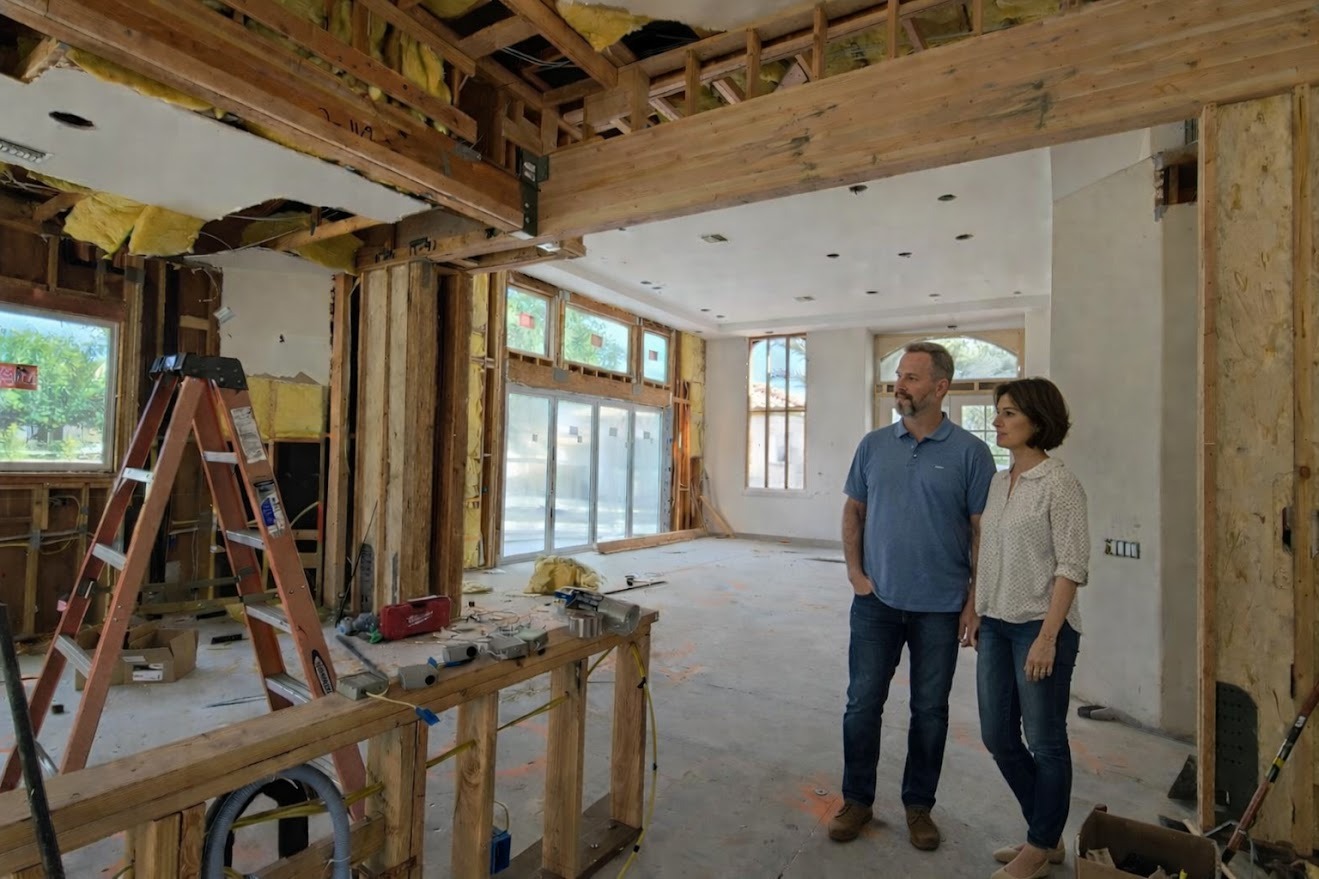
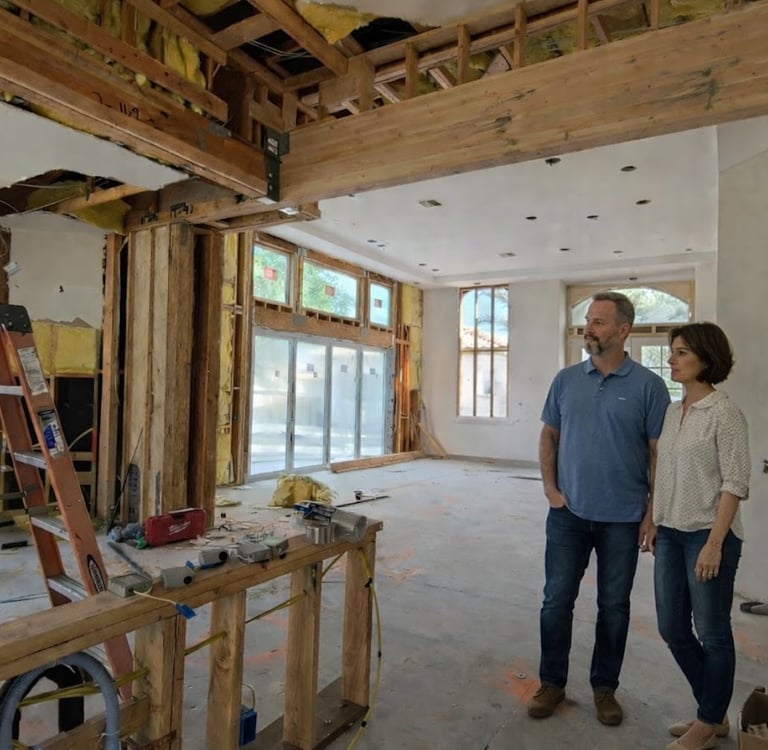
One Saturday morning, I met Cindy at their house to do a walkthrough now that demo was complete. With all the walls down, we could finally see the full scope of the transformation—what had been a formal living/dining room, family room/kitchen was now one wide-open great room. Basically, turning 2 living spaces, 2 dining spaces and 1 kitchen into ONE modern-family great room. The kind of transformation almost every family wants these days because formal spaces feel like such a waste.
But it was standing in that completely open space, looking through where the new multi-slide door would go, that we both saw it. The view to the pool and outdoor living area was spectacular. With walls in the way, we'd never fully appreciated the sightline.
That's when Cindy turned to me and said, "What if we moved the kitchen to the opposite wall?"
The original layout had been good—it flowed well and made sense because we were keeping the kitchen where all the electrical, gas, plumbing, and drainage already existed. That's why we hadn't considered swapping it. Moving it to the opposite wall would mean relocating all that infrastructure to where none of it currently existed.
But now, with the walls down and that view fully visible, we could both see what the change would create: a direct sightline from the kitchen island to the pool and outdoor living spaces through that huge wall of glass. Instead of looking at a wall while she cooked, Cindy could picture herself preparing lunch, looking directly out at her grandkids playing in the pool. The new clerestory windows would frame the mountain views and morning sunrises perfectly.
It was, honestly, a brilliant idea—but only possible to see once demo revealed the full picture.
Cindy headed home to discuss it with James. I knew this was a massive decision. We'd have to stop everything, get new plans drawn up, get numbers on what it would cost to move all the utilities and plumbing, and have all the cabinet plans redrawn.
If they went through with it, the project would be set back months. During the COVID construction boom, we started out the project with over 300 ahead of us on the city permit list. Between new architectural drawings, engineering, re-permitting, and exploding construction costs, this was huge.
They were already way over budget and way behind schedule.
Cindy and James were in their sixties—James approaching seventy. This house was their forever home. They joked that they'd only leave when carried out in a pine box. They both worked incredibly hard since their teens and looking forward when they'd finally slow down and enjoy what they worked so hard for. They met in the corporate world years ago. Cindy, with aspirations of higher education, spent years studying nights and weekends to get her masters and then PhD, while climbing the corporate ladder during the day. She'd finally graduated in her fifties and landed her dream job as a professor at a prestigious university.
James was just beginning a well-deserved retirement. The plan was that they’d start the project after he retired so he could keep an eye on things and be available when decisions were needed.
I knew Cindy and James well by this point. We'd spent social time together beyond the project. They were deeply in love and committed to each other. I could see it every day in their interactions—deep respect, unwavering trust, and grace toward one another. They had the kind of marriage, communication, and partnership that sets an example for everyone around them.
I waited anxiously to hear what they'd decide. Would they make this expensive, timeline-destroying change? Or stick with the approved plan?
The email from them came faster than I expected, late that very evening: They were doing it!
This change wasn't really about construction logistics. It was about what the space would mean to Cindy, how she and James would live in and enjoy their home. Since James was the one overseeing the day-to-day work, he was painfully aware of the spiraling costs and the evaporating timeline.
Yet I had a strong feeling about what really happened that evening, as they talked about what this change would mean. From James's perspective, this was not a case of "Happy Wife, Happy Life" in the eye-rolling, satirical sense.
This was James genuinely, sincerely wanting to do whatever would make Cindy happiest. This was the home she'd dreamed about for years—she'd shown me her Pinterest boards filled with ideas she'd been collecting. This was where they would spend the rest of their lives together. They were a family of deep faith, commitment, and gratitude for what they'd built together. As partners, they gave the go-ahead.
The project took a long time, but it was all worth it in the end. When reveal day came and we did the final walkthrough, Cindy was beaming and tearing up with joy. She was beyond happy to see her dream come to life—every big detail and small touch she'd imagined.
James was happy too. Relieved it was done for sure, and proud of how everything turned out. But his deepest joy? Watching Cindy's face as she walked through that kitchen, looking out at the pool through that wall of glass.
Happy wife? Yes. Happy life? Absolutely. But it meant something completely different than the joke suggests.
I've seen so many couples navigate their remodels with this same unspoken philosophy running through their decisions. You'd think there would be more arguments, more push and pull—and I'm sure some of that happens behind the scenes. But what I consistently witnessed was heartening: spouses who genuinely wanted what was most important to the other. They wanted their partner to be happy above any "win" in the remodel decision-making process.
I still connect with Cindy and James occasionally. I love hearing stories about family visits, barbecues at the outdoor kitchen, the house full of people, the grandkids in the pool, even their dogs splashing around. Every story comes back to that kitchen, that view, that decision James supported even when it cost them months and money they didn't have to spare.
Remodels aren't just about space and design. They're about creating what's most important to you—a truly happy life, together.
THE PROJECT THAT SHOWED ME BOTH PATTERNS IN ACTION
Some projects stay with you forever. Anthony and Sue's remodel was one of those—not because of the scope or the budget, but because watching them work together taught me more about partnership than any other project I'd managed.
I'm standing at the edge of a spectacular grotto in a neighborhood where I was managing a major remodel for my clients, Anthony and Sue. We were there to look at the neighbor's water feature—a full-story waterfall cascading into a grotto surrounded by lush tropical plants, massive boulders, fancy fire bowls, and intricate lighting. This wasn't a water feature. This was a lake. Well, maybe a pond. But massive.
I could see Sue's vision forming as we stood there listening to the water. I knew her by now—she had excellent taste, beautiful vision, and they had significant resources. I could feel her imagining this in their courtyard.
And honestly? It would be stunning. Their courtyard wasn't nearly as large, but it could be just as magical. One side was a long wall of windows looking out from the main living room with mountain views that seemed close enough to touch. Perfect for shaded summer afternoons when the main patio was too hot, beautiful for morning coffee watching the sunrise crest the mountains.
But there was one big problem with this stunning vision.
This project was supposed to be a flip. An investment property. The second one I was managing for Anthony and Sue, and they were approaching it with the same strategy that had made their first flip a massive success—quick turnaround, great refresh results, touching most surfaces but no major structural changes. That first project had perfect timing and an unusual financial payoff. They made a lot of money in a short period of time.
They'd taken that profit and bought a bigger house with even bigger upside potential. But it needed a lot of work. The kitchen was awful. The flow had issues that couldn't be easily fixed. And the exterior—the side of the house with what I called the "money shot," the most spectacular views in the neighborhood—desperately needed attention.
I'm talking sweeping views of a double-fairway golf course, the most golf course frontage I'd ever seen, expansive elevated mountain views with only a few distant homes visible. It was breathtaking. And that was the only beautiful thing about that side of the house.
The pool was surrounded by broken flagstone, dirt, and ants. Huge concrete dolphins spit streams of water into the pool. A patio cover with massive columns blocked the stunning views. Balustrades that looked like they belonged at Hearst Castle. And the most painful issue—the best view in the entire house from the kitchen was completely blocked by columns and an overgrown rose garden. You could barely see the lakes and fairways past them.
So an expensive grotto on the other side of the house, the side that didn't have the problems we needed to solve for resale? Not in a flip budget.
This is where the story becomes about partnership.
A few days after our visit to the neighbor's grotto, I got a call from Anthony. He was the numbers guy, the one who analyzed ROI and kept us focused on what would bring the best return. I expected him to say what I was already thinking: "It's beautiful, but we can't justify it."
Instead, he said: "Let's do the grotto. Sue has a vision for it, and I trust her. Let's do it all."
And we did. We did it all.
We completed a major pool remodel—goodbye, concrete dolphins. We demolished the patio columns and installed a huge steel beam to open up the view massively. We added extensive landscaping over the entire property, including around the grotto in the courtyard. We even replaced the broken concrete and gravel front driveway with real turf in a beautiful curved design.
What was really happening—what evolved over time, over a very long time because we kept adding projects—was that they were making it their home. As the project grew in size and cost, Anthony started saying that if they couldn't make a profit on the house, they'd move into it themselves.
And that's exactly what they did. They made it their own, and they made it spectacular.
One space inside that Sue always paid special attention to was the sunken library. It was enclosed on one side by an awful stained glass wall—probably special to someone at some point—and a smaller one on the other. We removed the stained glass and added beautiful wrought iron railings. We cleaned up the built-in bookshelves and removed the dusty shades that had blocked the view from the rounded wall of tall windows looking out to the mountain view and north garden.
The library was a few steps down from the main living room, just off to the side. It had this old, beautiful grand fireplace. It was a sanctuary—secluded from the main living areas but still somehow at the heart of the house.
I didn't fully appreciate what Sue was doing when she kept paying special attention to that library. I knew she was having fun planning the grotto with me and working on all the outdoor projects. But the library? I didn't get it.
Not until later, when I helped them prepare their old house for sale.
Anthony's "office" in their previous home was literally a tiny desk shoved in the back corner of their bedroom. He did all his computer work, all his spreadsheet analysis, sitting in the bedroom staring at a wall.
When I visited the new house after they'd moved in and saw Anthony at the big curved desk that had been left behind by the previous owners, sitting in that beautiful sunken library—I got it.
Anthony finally had a space of his own. Not a corner of the bedroom, but a warm, quiet sanctuary at the heart of the house. Surrounded by garden and mountain views, bookshelves and fireplace. A place that was just for him.
Sue had seen what he needed and created it for him, just as he had trusted her vision for the grotto.
This project was an ever-evolving journey born out of mutual respect and love. Anthony trusted Sue's design vision even when it didn't make financial sense on paper. Sue honored what Anthony needed even though he'd never asked for it directly. They both understood when to lead and when to follow, when to push for what mattered and when to defer to what mattered more to their partner.
Both patterns I'd observed in successful couples—they were both there in this one project.
That fall, I had the honor of being invited to the family's Thanksgiving dinner. Anthony found the perfect spot for his turkey deep fryer on the back patio, right near the north garden swing where he loved to rest his eyes on quiet afternoons. After hours in the kitchen, Sue and her sisters sat on the new steps that went across the pool with their feet dangling in the water, wine glasses in hand. Just a year before, they would have been standing in that overgrown rose garden, unable to see anything but thorns and leaves.
Anthony and his son Adam pulled out the crown jewel of the Thanksgiving dinner—a perfect golden-brown turkey. We dined at the table looking directly at the courtyard grotto with the fire bowls glowing, making sparkles dance across the water.
It was a special day with a big, loving family that Anthony and Sue were so proud of.
This was ten years ago. They sold that house just a few years after finishing it, moving to something larger to accommodate the grandkids who were on the way. Even with all the added projects—so far beyond the original flip intention—and changes in the market, they broke even on the investment. That house today is worth more than double what they paid for it.
Anthony has since passed. Sue has many grandchildren now who help fill the void. And Adam is now the master of the deep-fried turkey at Thanksgiving.
But what Anthony and Sue built together—it wasn't really about the grotto or the library or even that spectacular house. What they built was a partnership based on mutual respect and trust. They showed their children what it looks like when two people truly honor each other's visions, support each other's dreams, and create something beautiful together.
That's the legacy that lives on. That's the north star their children navigate by in their own relationships. And that's what made managing their project such an honor—I wasn't just watching a house transform. I was watching what real partnership looks like.
WHAT THESE COUPLES TAUGHT ME ABOUT RENOVATING TOGETHER
After managing remodels for 30+ couples, I can tell you with certainty: the renovation itself isn't what tests a relationship. What tests a relationship is how you approach decision-making under pressure.
The couples who struggled weren't dealing with more difficult contractors or worse budget overruns. They were dealing with the same challenges everyone faces. The difference was in how they treated each other when those challenges arose.
The successful couples I worked with—like Derrick and Lisa, Cindy and James, Anthony and Sue—shared something fundamental: they viewed the remodel as a project they were tackling together, not a battlefield where they had to defend their individual positions.
They recognized each other's strengths and let the right person lead on the right decisions. They understood that making their partner genuinely happy wasn't about "giving in" or "losing"—it was about creating a home that worked for both of them. They trusted each other's judgment even when they didn't fully understand the reasoning in the moment.
Most importantly, they never forgot why they were doing this in the first place. The goal wasn't to win arguments about tile selections or prove who had better design taste. The goal was to create a space where they could build their life together.
Here's what I wish more couples understood before starting a remodel: the house you're creating matters far less than the partnership you're strengthening (or damaging) while you create it. The tile will chip. The paint will fade. The trendy design choices will eventually date themselves.
But the pattern you establish for how you work through challenges together? That becomes the foundation for everything that comes after—not just in your home, but in your life.
The renovation will end. Your partnership continues.
Ten years later, I still think about that Thanksgiving dinner at Anthony and Sue's house. The grotto was beautiful, sure. The library was perfect. But what I remember most is watching a family celebrate together in a space that was created through mutual respect, trust, and genuine love.
That's what successful remodels are really about. Not the Pinterest-perfect kitchen or the spa-like bathroom. It's about two people figuring out how to honor each other's dreams while building something bigger than either of them could create alone.
If you're planning a remodel with your partner, ask yourself: What pattern are we establishing? Are we playing to each other's strengths? Are we genuinely supporting what matters most to the other person? Are we treating this as a shared project or a series of negotiations to win?
The answers to those questions will determine far more than what your house looks like when you're done.
They'll determine what your partnership looks like when the dust settles and you're finally sitting together in that beautiful new space you created.
Make it count.
Contact@RenoPLNR.com
The first complete remodel planning system built specifically for homeowners.

Austin, Texas
2026 RenoPLNR™ All rights reserved
FOR PROFESSIONALS
Contact@RenoPLNR.com